




7°C
Porth, Newquay, Cornwall. UK
Updated17/11/2025 10:00 


ESA Top News

The European Space Agency (ESA) is Europe’s gateway to space. Its mission is to shape the development of Europe’s space capability and ensure that investment in space continues to deliver benefits to the citizens of Europe and the world.
ESA Top News
ESA Top News

ESA Top News

March 20th, 2025 09:00:00 EDT -0400 Read ESA's Strategy 2040

ESA's Strategy 2040

Read the Five Goals

April 12th, 2017 10:25:00 EDT -0400 Sentinel-6 mission

Copernicus Sentinel-6

November 17th, 2025 03:00:00 EST -0500 Sentinel-6B launch highlights
Video: 00:02:09

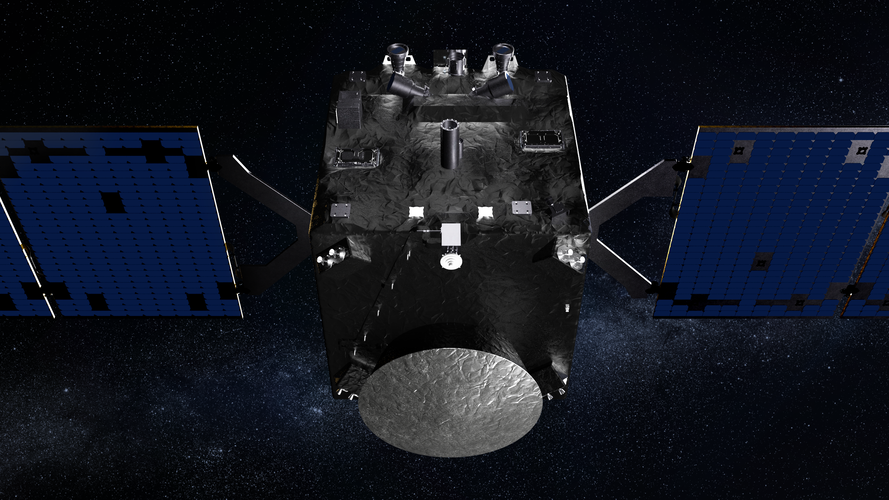
Copernicus Sentinel-6B was launched on 17 November 2025, ready to continue a decades-long mission to track the height of the planet’s seas – a key measure of climate change. The satellite was carried into orbit on a Falcon 9 rocket from the Vandenberg Space Force Base in California, US.

Sentinel-6B follows in the footsteps of its predecessor, Sentinel-6 Michael Freilich, which was launched in 2020. The mission is the reference radar altimetry mission that continues the vital record of sea-surface height measurements until at least 2030.

Copernicus Sentinel-6 has become the gold standard reference mission to monitor and record sea-level rise. The mission’s main instrument is the Poseidon-4 dual-frequency (C-band and Ku-band) radar altimeter. Developed by ESA, the altimeter measures sea-surface height. It also captures the height of ‘significant’ waves as well as wind speed to support operational oceanography.

November 17th, 2025 01:56:00 EST -0500 Sentinel-6B launched to extend record of sea-level rise
Sentinel-6B separates from rocket

The latest guardian of our oceans has taken its place in orbit. The Copernicus Sentinel-6B satellite is now circling Earth, ready to continue a decades-long mission to track the height of the planet’s seas – a key measure of climate change.

November 14th, 2025 10:00:00 EST -0500 A solar prominence hovers over the Sun
Video: 00:00:22

The Sun is always mesmerising to watch, but Solar Orbiter captured a special treat on camera: a dark â€˜prominence’ sticking out from the side of the Sun.   

The dark-looking material is dense plasma (charged gas) trapped by the Sun's complex magnetic field. It looks dark because it is cooler than its surroundings, being around 10 000 °C compared to the surrounding million-degree plasma.  

When viewed against the background of space, the hovering plasma is referred to as a prominence. When viewed against the Sun's surface, it is called a filament. (In this image you can see examples of both.) 

Solar prominences and filaments extend for tens of thousands of kilometres, several times the diameter of Earth. They can last days or even months. This video shows one hour of footage, sped up to make movement more clearly visible.  

Solar Orbiter recorded this video with its Extreme Ultraviolet Imager (EUI) instrument on 17 March 2025. At the time, the spacecraft was around 63 million km from the Sun, similar to planet Mercury. 

Solar Orbiter is a space mission of international collaboration between ESA and NASA. The EUI instrument is led by the Royal Observatory of Belgium (ROB). 

[Video description: Close-up video of the Sun, filling the left half of the view, its surface covered what looks like moving, glowing hairs accompanied by some short-lived bright arcs. Protruding to the right, in the centre of the video, is dark material that looks almost feathery, with thin streaks flowing both away from and towards the Sun.] 

November 14th, 2025 09:15:00 EST -0500 Week in images: 10-14 November 2025
3D-printed space metal under microscope

Week in images: 10-14 November 2025

Discover our week through the lens

November 14th, 2025 04:09:00 EST -0500 ESA pinpoints 3I/ATLAS’s path with data from Mars
ExoMars Trace Gas Orbiter observes comet 3I/ATLAS – GIF

Since comet 3I/ATLAS, the third known interstellar object, was discovered on 1 July 2025, astronomers worldwide have worked to predict its trajectory. ESA has now improved the comet’s predicted location by a factor of 10, thanks to the innovative use of observation data from our ExoMars Trace Gas Orbiter (TGO) spacecraft orbiting Mars.

November 14th, 2025 04:00:00 EST -0500 Earth from Space: Prague
This very high-resolution image captures the beautiful medieval core of the Czech capital, Prague. Image: This very high-resolution image captures the beautiful medieval core of the Czech capital, Prague.
November 13th, 2025 08:10:00 EST -0500 Brazil gears up to harness ESA’s Biomass data
Forest floor and forest canopy

As the COP30 climate conference gets underway in Brazil, the world’s attention is once again drawn to the plight of the Amazon – the planet’s largest and most vital rainforest. With the European Space Agency’s Earth Explorer Biomass satellite now in orbit, ESA is helping Brazil prepare to transform this new mission’s groundbreaking data into actionable knowledge for protecting the rainforest and confronting climate change.